AI alone won’t save your lab. Here is
A practical 7-Step Roadmap to reduce complexity, refocus lab staff and scientists.
Modern labs are at a critical turning point,and the window for action is closing. The demands on management of analytical labs continue to grow. Pressure for change has never been higher. But this pressure creates opportunity: with the right approach, labs can turn complex challenges into measurable value for both research outcomes and business goals. The reality after 20 years in lab organizations: Labs that act now gain a decisive competitive advantage. Those that wait lose ground that even AI can’t recover.
Why Now?
The Cost of Inaction.
Fragmented systems, manual processes, and mounting compliance requirements drain capacity and create compounding risks. If you continue working the way you always have, you’ll fall behind,and the gap will only widen. Here’s what happens when labs maintain the status quo:
- Innovation stalls. Scientists spend valuable time on administrative tasks and data searches instead of advancing research. In many organizations, researchers dedicate 25% or more of their time to non-scientific activities,searching for information, manually entering data, or navigating disconnected systems.
- Errors multiply. When information gaps and media breaks persist across systems, mistakes become inevitable. Each manual data transfer is an opportunity for error. Each disconnected system is a point of failure.
- Responsiveness drops. Decision-making suffers when critical data is incomplete, outdated, or scattered across multiple platforms. In fast-moving research environments, this delay can mean the difference between breakthrough and missed opportunity. The root cause? Many labs have introduced countless systems over recent years,LIMS, ELN, inventory management, compliance tools,without considering interoperability or long-term integration strategy.
- Staff fluctuation amplifies all of this. Every departure takes process knowledge with it and forces the remaining team to cover gaps while onboarding new colleagues. In a market already facing structural workforce shortages, labs without simple, robust, digitalized processes spend more time in “learning mode” than in “performing mode”.
The result is a patchwork that blocks progress rather than enabling it.
Four Strategic Recommendations for Future-Ready Analytical Labs
Before diving into tactical implementation, lab managers must address four foundational elements:
(1) Make Processes visible
You can’t improve what you can’t see. Conduct a comprehensive inventory of current lab workflows:
- Where do media breaks occur between systems?
- When and why is data entered multiple times?
- Who needs access to which information, and when?
- Which manual workarounds have become “standard practice”?
Tools like process mapping, value stream analysis, or digital process mining provide rapid transparency. But the real value comes from involving the people who do the work daily,scientists and lab technicians know where the friction points are.
Action step: Start with a focused pilot in one lab area. Map the complete workflow from sample receipt to final report. You’ll likely discover inefficiencies you never knew existed.
(2) Break Down Silos Strategically
Organizational silos are the silent killer of lab efficiency. Different departments, sites, and teams often work in parallel,duplicating efforts, using incompatible standards, and struggling to share critical information. Bring key stakeholders to the table: lab managers, scientists, IT teams, quality assurance, and business stakeholders. Open dialogue about challenges and bottlenecks alone reveals hidden potential.
The goal: Establish shared standards and clearly defined responsibilities that create smooth collaboration across boundaries. This isn’t about forced standardization, it’s about enabling productive collaboration. Teams should retain flexibility where it matters while aligning on what’s essential for seamless information flow.
Action step: Hold a cross-functional workshop focused on one specific pain point (e.g., sample tracking or documentation workflow). Define common terminology, data formats, and handoff procedures.
(3) Understand Digitization as an Enabler, Not an End in Itself
Technology for technology’s sake creates more problems than it solves. New tools only deliver value when they genuinely simplify processes and provide tangible benefits to end users. This requires a different approach than traditional IT implementations:
- Involve teams early. Scientists and lab technicians must participate in solution selection and configuration. They know what will work in practice versus what looks good in a demo.
- Test in small circles. Pilot new solutions with a core group of users. Gather feedback. Iterate. Refine. Only then scale across the organization.
- Measure real impact. Track time saved, errors reduced, and user satisfaction,not just implementation milestones. When done right, the investment pays off through fewer errors, higher speed, improved compliance, and measurable results.
Action step: Before purchasing or implementing any new system, define specific success criteria with input from actual users. What tangible outcomes will justify the investment?
(4) Leadership for Scientific Progress
Transformation doesn’t happen through technology alone,it requires committed leadership at every level. The responsibility lies with C-suite executives, lab directors, and team leads together. Progress happens when change isn’t viewed as a burden but as a lever for creating clarity, efficiency, focus and genuine value.
Key leadership behaviors:
- Champion the vision of simplified, integrated lab operations
- Allocate dedicated time and resources for transformation
- Celebrate early wins and learn from setbacks
- Maintain focus despite competing priorities
A structured, participatory approach helps shape transformation that serves not just the lab, but the entire organization’s strategic goals.
The 7-Step Transformation Roadmap
With foundational principles established, here’s the concrete roadmap to reduce complexity and refocus scientists on actual projects and research:
Step 1: Capture the Current State
Make all lab processes transparent and measurable:
- Document where data originates and how it flows through systems
- Identify every media break or manual workaround
- Map information dependencies across teams and functions
- Survey scientists and staff directly about practical barriers
Outcome: A clear baseline showing where capacity is consumed versus where value is created.
Step 2: Break Down Data and Workflow Silos
Bring together key people from different teams, sites, and functions to define shared process maps and standards:
- Standardize data formats and naming conventions
- Align documentation requirements across departments
- Create common definitions for key metrics and KPIs
- Establish clear ownership and accountability for each process
Outcome: Reduced duplication, clearer handoffs, and faster information flow.
Step 3: Drive Digital Integration Strategically
Create a future-ready digital foundation,a central system or tightly integrated suite that covers:
- Lab data management (LIMS/ELN/CDS/…)
- Documentation and compliance
- Inventory and supply chain
- Equipment maintenance and calibrationConnect devices, instruments, and existing tools seamlessly via interfaces and APIs. Eliminate manual data transfers wherever possible.
Outcome: A connected digital ecosystem where information flows automatically and accurately.
Step 4: Automate Routine Tasks and Optimize Processes
Free researchers from administrative burden by automating:
- Data entry and transfer between systems
- Approval workflows and sign-offs
- Compliance documentation and audit trails
- Report generation and distribution
- Inventory alerts and reordering Implement digital workflows that match proven procedures,including automatic notifications, version control, and complete traceability.
Outcome: Scientists spend time on science, not paperwork.
Step 5: Foster Transparency and Collaboration
Make all relevant data and experimental context centrally accessible to authorized users:
- Implement role-based access controls for security
- Create searchable repositories of experimental data and protocols
- Enable cross-team visibility into project status and results
- Establish knowledge-sharing platforms and best practice libraries
- Encourage regular cross-departmental meetings and collaboration forums where teams share learnings and solve problems together.
Outcome: Faster problem-solving, reduced duplication, and accelerated innovation.
Step 6: Ensure Training and Change Management
Technology changes fail without proper adoption support. Provide:
- Practical, role-specific training for all digital solutions
- Ongoing support as processes evolve
- Clear documentation and self-service resources
- Regular feedback channels to surface issues early
- Tailor training to different roles and skill levels. A lab director needs different information than a bench scientist or lab technician.
Outcome: High user adoption, minimal disruption, and sustainable change.
Step 7: Measure, Report, and Continuously Improve
Define clear metrics that matter:
- Process efficiency (time from sample to result)
- Error rates and rework frequency
- Compliance incidents and audit findings
- Scientist time spent on research versus admin
- Overall lab throughput and capacity utilization
- Review results regularly
- Use data analytics to identify improvement opportunities and validate that changes deliver expected benefits.
Outcome: Continuous optimization driven by real performance data.
The Reality of Implementation
This roadmap sounds comprehensive, because it is. But it’s also achievable. Our approach is built on clear structure, realistic timelines, and full involvement of relevant staff and stakeholders. We don’t believe in massive, disruptive overhauls.
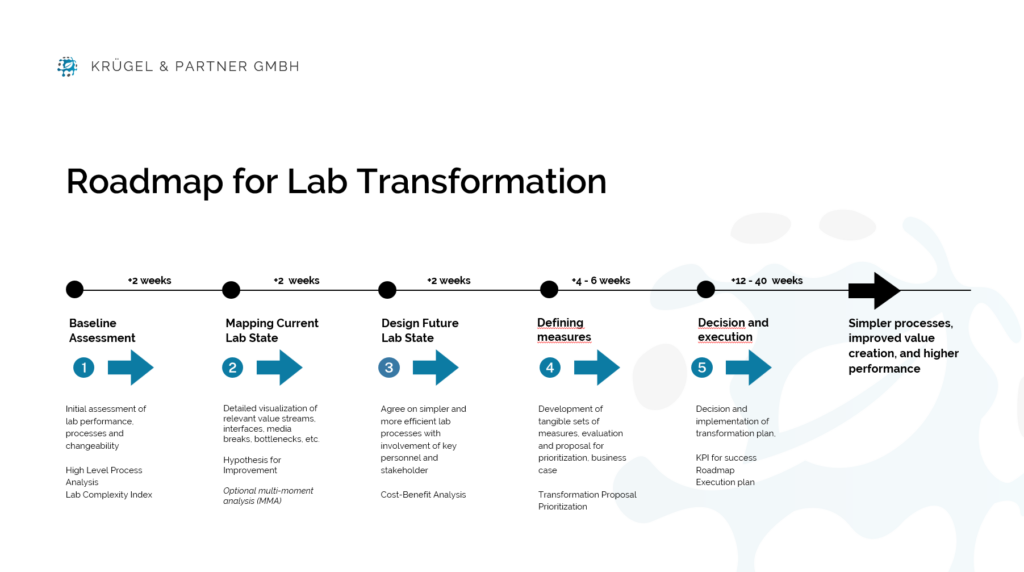
Our Roadmap for Lab Transformation
Typically, we start transforming within 12 weeks of the project kick-off by working on prioritised work packages. We believe in focused, sequential improvements that build momentum in hte organisation. The typical outcome: 10-20% productivity improvement within 12 months.For labs with lower initial complexity, results come even faster. The key is maintaining discipline and focus throughout the journey.
What makes This Approach Different
Unlike traditional consulting or technology implementations, our approach delivers sustainable results because:
- Employee involvement identifies invisible barriers early. The people doing the work know where the problems are. By actively engaging them in both diagnosis and solution design, we surface issues that would otherwise remain hidden until after implementation.
- Existing ideas are promoted and enhanced. Lab teams often have great ideas for improvement but lack the structure or authority to implement them. We create the framework that turns good ideas into reality.
- The team actively participates in change. When people help design the solution, they own it. This increases commitment, reduces resistance, and ensures changes stick long after we leave.
From Patchwork to Performance
Following this roadmap moves your lab from a fragmented patchwork to an efficient, robust organization where new processes become embedded in the organizational DNA. This creates space for what truly matters: advancing insights and science, not managing the status quo.
The outcome is measurable and sustainable:
- Scientists focus on research, not administration
- Errors decrease as manual processes are eliminated
- Compliance becomes simpler and more reliable
- Decision-making improves with better data access
- The lab operates as a true strategic asset to the business
Ready to Transform your Lab?
The question isn’t whether your lab needs to change, it’s whether you’ll lead that change or be forced to react to it. If you want to make your lab organization future-ready with less complexity, clear processes, and motivated teams, now is the right time to take the first step.
We support analytical lab organisations with over 20 years’ experience in lab transformation.
- Practical current-state assessments that reveal hidden opportunities
- Collaborative development of prioritized action plans
- Structured implementation with measurable milestones
- Change management that ensures lasting adoption
The result? Modern labs that work efficiently, maintain rigorous compliance and collaborate with business stakeholders on an equal footing. It’s only a few weeks away!
More information:
- Impact of Retention, Standardization and Process Simplification on Lab Performance: Lab Performance Effects or LinkedIn Post
- Impact of Complexity on Lab Productivity: Complexity eats productivity and focus
- How to reveal and unlock hidden capacity: Find hidden capacity in your lab